New polling shows broad public concern about climate change and strong support for action to tackle methane pollution
FOR IMMEDIATE RELEASE
The Hague, Netherlands – According to a new international poll, 85% of respondents across 18 countries support action to reduce methane pollution. The Global Methane Hub, in collaboration with the Yale Program on Climate Change Communication (YCCC), commissioned the international survey across 18 countries and four continents to measure and track public awareness of climate change and methane and examine attitudes toward methane reduction solutions around the world.
Reducing methane pollution is one of the fastest ways to slow global warming in the near term. Methane is responsible for roughly 30% of warming since preindustrial times and is more than 80 times as powerful as carbon dioxide over a 20-year period, with most methane breaking down within about a decade. Cutting human-caused methane emissions by 45% this decade could prevent nearly 0.3 degrees Celsius of warming by 2045, while improving air quality, protecting crops, creating jobs and strengthening communities worldwide.
“Across the countries surveyed, people who reported feeling climate impacts more directly were also more likely to support action, reinforcing the importance of solutions that respond to the challenges communities are experiencing,” said Marcelo Mena, CEO of the Global Methane Hub. “Reducing methane is one of the fastest ways to slow warming. The strong support reflected in these findings underscores the opportunity for policymakers to advance proven solutions across agriculture, waste and energy and build healthier, more resilient communities.”
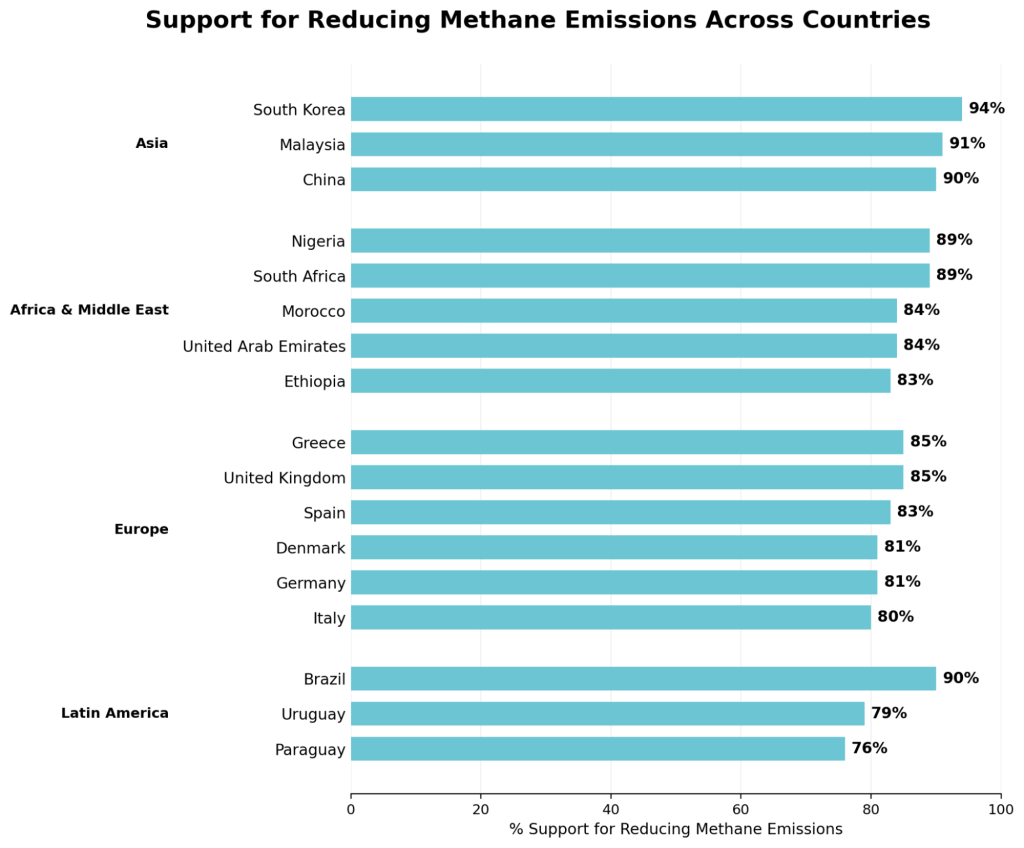
Across regions, the findings reveal broad public concern about climate change and strong support for action to tackle both climate change and methane pollution, even as the impacts people experience and the solutions they prioritize vary by country. Support for action to reduce methane emissions was particularly strong in Asia, Africa and Latin America, reaching 94% in South Korea, 91% in Malaysia, 90% in China and Brazil, and 89% in Nigeria and South Africa.
Support for reducing methane extends across major emitting sectors (waste, agriculture, and oil and gas), with an average of 86% of adults surveyed across the 18 countries supporting action to reduce methane emissions from waste. The findings also point to widespread expectations for greater action from both governments and industry, with the majority of adults surveyed across countries calling for policymakers to do more to reduce methane emissions.
The majority of adults who responded to the survey said they would view policymakers who take steps to reduce methane emissions more favorably. In all 18 countries surveyed, at least half of respondents favor policymakers who act on methane, with favorability reaching 76% in Nigeria, 74% in China, 73% in Indonesia and 72% in Brazil.
Adults surveyed are increasingly focused on the tangible effects of a changing climate in their communities, from extreme heat and wildfires to drought, flooding and water quality challenges. Across the countries surveyed, the more a respondent reports experiencing the impact of climate change, the more supportive they are of actions to reduce methane emissions, reinforcing the connection between the effects people see and feel in their daily lives and their desire for solutions.
“Understanding what people know and think is essential to effective public communication and policymaking,” said Dr. Anthony Leiserowitz, director of the Yale Program on Climate Change Communication. “Methane reduction is one of the fastest ways to limit global warming, making it critical that the public understands both the challenge and the solutions. This research helps provide the data needed to identify public knowledge gaps, strengthen communication campaigns, and help informed citizens participate in these climate change solutions.”
Strong Support for Methane Action Around the World
The survey found broad support for reducing methane emissions in various countries:
Courtesy of the Global Methane Hub
Asia
Africa & Middle East
Europe
Latin America
“The consistency of these findings sends a clear signal: support for reducing methane emissions is strong and sustained,” said Melissa Bell, Senior Vice President, Research at Global Strategy Group, GMH’s partner in conducting the survey. “People are concerned about the impacts of climate change, they support action across the major sources of methane emissions, and they expect those with the greatest ability to make a difference to take responsibility.”
View the full results here.
** Global Methane Hub is available for interviews. To request more information or an interview, please contact [email protected] **
About the Global Methane Hub
The Global Methane Hub organizes and unites governments, industry leaders, scientists and nonprofit organizations across the globe to minimize methane pollution through technology and common-sense public policies and regulations. We have raised over $500 million in pooled funds from more than 20 of the largest climate philanthropies to accelerate methane mitigation across the globe.
Survey Methodology
Global Strategy Group conducted a 10-minute online poll between August 3 and August 25, 2026, translated into 13 languages across Europe, South America, Africa and Asia.
In each country, responses were collected from people currently residing in the country who are 18 years of age or older and who have internet access. Weights were applied to age, gender, geography and education to ensure collected samples were representative of adults 18+ who have internet access in each country.
A minimum of 700 responses were collected in 15 countries: Denmark, the United Kingdom, Germany, Greece, Spain, Italy, the United Arab Emirates, Nigeria, South Africa, China, Indonesia, Malaysia, South Korea, Morocco and Brazil. The margin of error is ±3.7% for these countries, with the exception of Morocco and Brazil, where it is ±3.6%. In the remaining three countries, a minimum of 400 responses were collected. The margins of error are ±4.9% in Ethiopia, ±4.5% in Paraguay and ±3.9% in Uruguay.