Marcelo Mena |
COP30 was the COP of action—rooted in the energy of the Amazon from the official COP30 mascot of the Curupira, fierce protector of the forest, to the demonstrations by Indigenous communities reminding us that we may not all be in the negotiations room, but we are all a part of the solution. This year, more than ever before, we are witnessing global ambition meet local implementation. Through it all, one message rang loud and clear: cutting methane pollution is the way to pull the emergency brake on global warming.
This year’s conference was not only about pledges—it was about proof of progress, data transparency, and concrete plans for continued action. Across sectors and regions, we saw ideas on methane emissions reduction become real: governments strengthened commitments, practitioners advanced practical solutions, and communities led with innovation on the ground. With new tools to measure methane with unprecedented accuracy, from satellites that detect super-emitters in real time to local monitoring systems that track progress on the ground, data is becoming a catalyst for transparency, accountability, and action.
But progress is not measured by data alone—it’s reflected in lives improved and communities transformed. That’s why the Global Methane Hub is working hand in hand with local partners to translate global ambition into tangible impact.
 In the months leading up to COP, the Global Methane Hub team worked with our grantee Instituto Pólis to set up Belém’s first organic waste segregation and composting facility run by waste pickers. This effort created jobs and infrastructure that will leave a legacy far beyond COP30, and will demonstrate a model that can be replicated across Brazil, Latin America, and the world for low-waste, low-methane cities.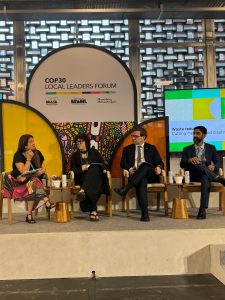
The week prior to COP provided an excellent springboard. To start, at the C40 World Mayors Summit in Rio de Janeiro, we announced a $10 million investment (USD) to help LatinAmerican and Caribbean cities cut methane emissions from waste. The next day, we announced our new globally coordinated research accelerator to fast-track innovations that reduce methane emissions from rice cultivation, led by Hayden Montgomery, our Agriculture program director. This $30 million investment, with an ultimate goal of raising $100 million, will advance low-emission rice production that maintains yields, conserves water, and benefits farmers, consumers, and the planet.
We couldn’t do this work without funders like Bloomberg Philanthropies, who announced a new $100 million investment to accelerate the detection and repair of methane super-emitters worldwide. Methane accounts for nearly half of recent net global warming, and yet less than two percent of climate finance targets methane, making investments like these crucial in the race to halt climate change.
Just before COP kicked off, on November 7, members of the Climate and Clean Air Coalition including the United Kingdom, Japan, Kazakhstan, The Latin American Energy Organization (OLADE), and the European Commission issued a joint declaration, “Drastically Reducing Methane Emissions in Global Fossil Fuel Sector.” As our Energy program director, Sarah Ann Smith, put it, the agreement “was another step toward achieving significant reduction in methane emissions to create an opportunity to slow climate change.”
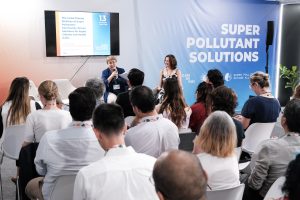 With that momentum, we kicked off COP30 advancing strategies that reduce methane pollution through partnerships and investment. Throughout the conference, we stayed true to our role as a regranter, convener, and advocate by co-hosting the Super Pollutant Solutions Pavilion. Alongside the Clean Air Fund and the Super Pollutant Action Alliance, we convened governments, philanthropies, scientists, and civil society to advance collective action on methane in Belém. Through a series of high-level dialogues and collaborative events, the Pavilion became a space for sharing tactics and strategies that work, aligning action plans, and accelerating the momentum needed for a decisive decade of climate progress.
In week one, we had two major announcements. We launched a new collaboration with the Global Green Growth Institute to integrate methane-smart practices into financial systems and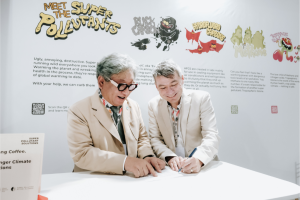 national development strategies across Mexico, Nigeria, and Senegal—aiming to mobilize more than $400 million in methane abatement financing. Then, at the United Nations Framework Convention on Climate Change, I joined Carolina Urmeneta, our Waste & Circular Economy program director, to announce a $30 million investment in the Circular Economy NOW! Initiative. This is a global effort led by the COP30 Presidency, UN Environment Programme (UNEP), and the Climate and Clean Air Coalition to transform organic waste into opportunity. By connecting cities, waste pickers, food banks, and the private sector, this initiative will cut methane from landfills while creating green jobs and strengthening food systems. These efforts reflect the Hub’s mission to turn ambition into coordinated, investment-ready action that drives measurable impact for people and the planet. They also demonstrate how international collaboration can translate into practical local outcomes, proof that when local solutions are implemented, they deliver cleaner air, stronger economies, and more resilient communities.
 Over the weekend we screened episode one of our 31 Minutos methane series at the Latin American Youth Energy Transition Hub reception. The series we commissioned ahead of COP is a public information initiative to inform people in Spanish, Portuguese or English about what methane is and how we can decrease emissions, including steps we can take in our lives every day. It already has 4.5 million views across channels.
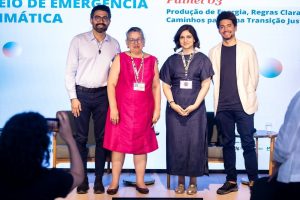
Throughout the final week, we continued to bring together scientists, experts, activists, policymakers, and philanthropists determined to reducing methane pollution. We co-organized the Methane: Climate Emergency Brake at the Museu das Amazônias in Belém alongside Uma Gota no Oceano and in partnership with Editora Globo and the Instituto de Desenvolvimento e Gestão. Henrique Bezerra, our Latin America regional lead, facilitated dialogue betweenspecialists, scientists, public managers, Indigenous leaders and other community leaders to discuss urgent solutions to reduce super-polluting gases with a special focus on methane.
In response to the Global Methane Status Report, I released a statement underscoring both the progress made since the launch of the Global Methane Pledge and the urgency of scaling up action. While policies and international cooperation have advanced, we must now harness local momentum to achieve global impact.
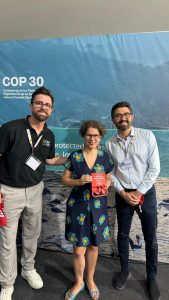 Lastly, Henrique joined leaders on the ground at the Progress on the Baku Declaration on Methane in the 2025 Nationally Determined Contributions (NDCs) of Latin America and the Caribbean event. There, alongside Ministers of Environment of Latin America and the Caribbean, the Hub promoted regional coordination commitments made at the previous COP and supported countries preparing methane-reduction measures for their 2025 NDCs. Through partners such as Resilum and the Climate and Clean Air Coalition, the Global Methane Hub stands ready to provide technical and financial assistance from assessment to implementation.
These closing moments at the COP of Action highlight both the urgency and opportunity ahead. Reducing methane delivers immediate climate and economic benefits, improves air quality, and strengthens public health worldwide. Building a sustainable future requires united effort.
As we close COP30, one message is clear: data without action is a missed opportunity. What matters most is how we use that data to drive accountability, guide investment, and empower communities. The Global Methane Hub exists to bridge that gap—turning information into implementation and insight into impact. Our mission remains clear: to build the systems, partnerships, and financing that move us from knowing to doing, ensuring that every data point leads to cleaner air, stronger economies, and a safer, more resilient future for all.
Sincerely,
Marcelo Mena
CEO, Global Methane Hub